Summary:
Whether your license renewal is coming up, your child just got flagged at a school screening, or you’re applying for a job that requires a vision test, the process can feel more confusing than it needs to be. What exactly does New York require? Who can do the test? And does it mean a trip to the DMV, or can your eye doctor handle it?
The short answer is: your eye doctor can handle most of it. Here’s what you need to know about New York’s vision requirements — and what they mean for you here in Suffolk County.
Driving Vision Test Requirements in New York
New York requires a minimum visual acuity of 20/40 — with or without corrective lenses — in either or both eyes to qualify for a standard driver’s license. If you need glasses or contacts to reach that threshold, a “B” restriction gets added to your license, meaning you’re required to wear them whenever you drive.
What most people don’t realize is that you don’t have to walk into a DMV office and hope for the best. If you see a licensed optometrist who’s enrolled in the NY DMV Online Vision Registry, they can submit your results directly to the DMV — which means you can renew your license online or by mail without ever setting foot in a DMV office. We’re enrolled in that registry, so when you come in for your exam, we handle the DMV submission for you. For anyone who’s sat in the Hauppauge or Riverhead DMV on a Tuesday morning, that’s not a small thing.
New York Vision Standards: What the Numbers Actually Mean
The 20/40 standard is the baseline, but it’s worth understanding what happens if you fall short of it. If your best-corrected vision is between 20/40 and 20/70, you may still qualify to drive in New York — but you’ll need a written statement from a licensed optometrist or ophthalmologist confirming your acuity level and verifying that your horizontal field of vision is at least 140 degrees. That field-of-vision component matters more than most people expect. You can have functional straight-ahead acuity and still have peripheral vision loss significant enough to affect driving safety — and DMV compliance.
If your vision is worse than 20/70 even with correction, New York will not issue or renew a standard driver’s license. That’s a hard stop, and it’s one reason getting a comprehensive exam before your renewal — rather than gambling on the DMV’s basic screening — is the smarter move.
One more thing worth knowing: DMV vision test results expire after 12 months, though your optometrist may specify a 6-month validity depending on your situation. Your license itself is valid for 8 years, so the vision test is a periodic checkpoint, not something you’re dealing with constantly. But when the window opens, being prepared matters — especially here in Suffolk County, where the vast majority of residents depend entirely on their car to get to work, run errands, and manage daily life. There’s no subway backup plan out here.
For CDL holders, the bar is higher. Federal DOT standards require 20/40 acuity in both eyes — not just one — with or without correction. Monovision contact lens correction is a disqualification for commercial drivers, full stop. If you drive a truck, a bus, or any commercial vehicle on Long Island’s roads, your vision requirements are governed by federal FMCSA rules, not just New York State standards.
What Happens If You Fail the DMV Vision Screening?
If you show up to a DMV office and fail their basic vision screening, you leave without a renewed license. You’ll be required to get a vision test from a licensed optometrist or ophthalmologist, obtain the appropriate documentation (typically Form MV-619, the Vision Test Report), and either return to the DMV or submit it through the Online Vision Registry process.
The better approach — and the one that saves you time — is to see your eye doctor before your renewal comes up. A comprehensive exam gives you a full picture of your visual health, updates your prescription if needed, and produces the documentation you need for DMV compliance all in one visit. If your optometrist is enrolled in the Online Vision Registry, they submit the results electronically and you’re done. No second trip, no waiting room.
It’s also worth addressing a common assumption: a lot of people think their vision is fine because they haven’t noticed any changes. Vision loss — particularly peripheral vision loss and early disease-related changes — tends to happen gradually. You adapt without realizing it. That’s exactly why the DMV requires periodic vision checks, and why a comprehensive exam catches things a basic acuity screening at a DMV counter simply won’t. The DMV is checking whether you can read a chart. A proper eye exam is checking whether your eyes are actually healthy.
If you’ve had LASIK or cataract surgery since your last renewal, it’s also worth noting that the corrective lens restriction on your license isn’t permanent. If your post-surgical vision meets the 20/40 standard without correction, you can have that “B” restriction removed — but you’ll need documentation from your eye doctor to do it.
School Vision Screening Requirements in Suffolk County
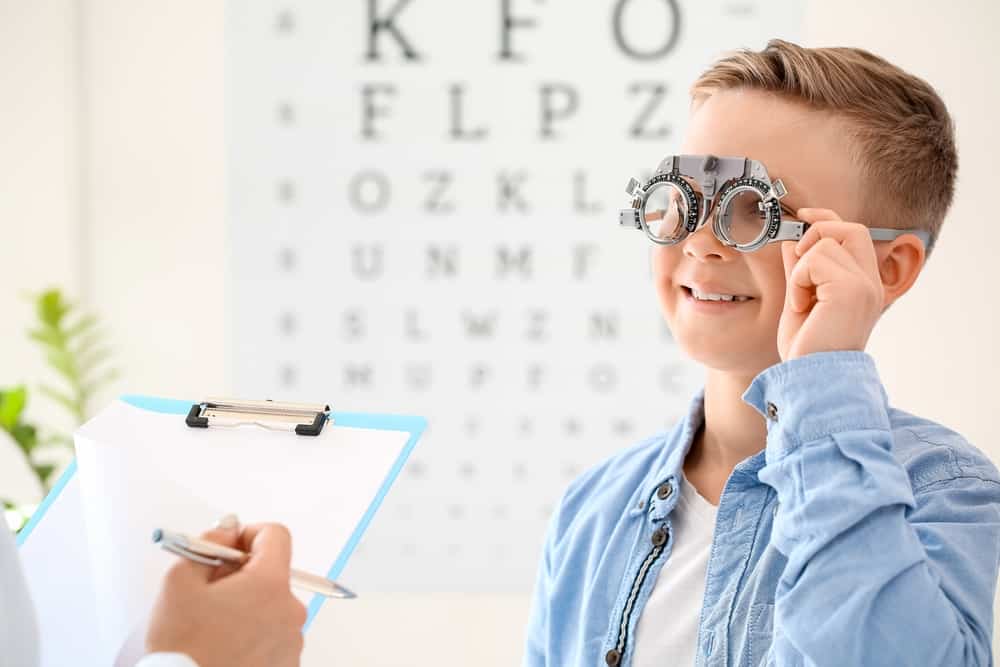
New York State requires vision screenings for students in Pre-K or Kindergarten, grades 1, 3, 5, 7, and 11, as well as all newly enrolling students. These screenings happen through the school nurse’s office and test distance acuity, near vision, and — for students new to the district — color perception.
When a child doesn’t pass, parents receive a referral to follow up with a licensed eye care provider. That referral is important, but so is understanding what the school screening actually tested — and what it didn’t.
Why a School Vision Screening Is Not the Same as an Eye Exam
This is the part most parents don’t know going in. A school vision screening tests one thing: how clearly your child can see at a set distance. It’s essentially a pass/fail check on distance acuity. It doesn’t evaluate how the eyes work together, how well they track across a line of text, how quickly they can shift focus from near to far, or whether there’s an underlying condition like amblyopia (lazy eye) or convergence insufficiency affecting how your child processes what they see.
Research from the American Optometric Association suggests that school screenings can miss up to 75% of children with vision problems. And of the students who are flagged and referred, around 61% never follow up with an eye doctor. That’s a significant gap — and for kids in districts like Sachem, Three Village, Smithtown, or Comsewogue across Suffolk County, it often means a vision problem goes unaddressed for years while the child struggles in school for reasons no one can quite explain.
Here’s the part that surprises a lot of parents: a child can pass a school vision screening and still have a meaningful vision problem. 20/20 distance acuity doesn’t mean the visual system is functioning well. There are 16 visual skills involved in reading and learning, and a basic Snellen chart tests exactly one of them. Conditions like convergence insufficiency — where the eyes have difficulty working together at close range — can produce symptoms almost identical to attention difficulties: losing your place while reading, avoiding near tasks, headaches after schoolwork. These conditions are diagnosable and treatable, but only if someone looks for them.
If your child has been referred after a school screening, or if they’re showing signs of reading difficulty, eye strain, or avoidance of near tasks, a comprehensive pediatric eye exam is the appropriate next step — not another screening.
Employment Vision Standards: What Jobs Require in New York
Vision requirements for employment vary significantly depending on the role, and Suffolk County has a large concentration of residents working in — or applying to — fields with strict standards. Understanding what’s required before your hiring physical can make a real difference in how you prepare.
For Suffolk County Police Department candidates, the standard requires corrected vision of 20/30 or better, with uncorrected vision no worse than 20/100 in each eye tested separately. Color vision is also evaluated. These aren’t suggestions — failing to meet them during the hiring process means disqualification, and candidates who are borderline should have a thorough exam well before their scheduled physical, not the week before.
New York State Police requirements are similar: uncorrected vision no worse than 20/100 per eye, correctable to 20/30, with correction achievable through glasses, contacts, or prior surgery. For MTA and Long Island Rail Road employees — another significant employer in Suffolk County — vision testing is part of the standard medical evaluation, and contact lens wearers are typically required to bring their glasses to the exam as well.
For CDL holders and commercial drivers, the federal DOT standard applies: 20/40 in both eyes with or without correction, and monovision contact correction is not permitted. If you drive commercially and you’re due for a renewal physical, your vision needs to be evaluated by someone who understands FMCSA requirements — not just a basic acuity check.
The common thread across all of these is that a comprehensive eye exam, done properly, gives you a clear picture of where you stand before a high-stakes evaluation. Showing up to a police or fire department physical without knowing your uncorrected acuity is an unnecessary risk. A thorough exam from a residency-trained optometrist gives you that information in advance — and gives you time to address any issues if needed.
Where to Get a Vision Requirements Exam in Suffolk County, NY
Whether you’re renewing your license, following up on a school referral, or preparing for a job that requires a vision evaluation, the process starts with a comprehensive eye exam from a provider who understands what’s actually being tested — and why it matters.
We’ve been serving patients across Suffolk County for over 25 years. We’re enrolled in the NY DMV Online Vision Registry, which means we submit your results directly to the DMV so you can renew online or by mail. We see pediatric patients, we handle difficult cases, and our residency-trained doctors have the clinical depth to catch what basic screenings miss.
If you have a deadline coming up — a renewal, a school referral, a hiring physical — don’t wait on it. Reach out to us and get the exam done right the first time.