Summary:
If you’ve recently moved to Suffolk County, just had a child, or realized your family hasn’t had a proper health checkup in longer than you’d like to admit — you’re not alone. Figuring out which providers to trust, what services are available nearby, and what actually counts as “preventive care” takes time most families don’t have.
This guide is designed to make that easier. We’ll walk through the key healthcare resources available across Suffolk County, with a specific focus on the Port Jefferson Station area — and we’ll make the case for why vision care, often the most overlooked piece, deserves a spot on your family’s annual checklist.
Pediatric Healthcare Providers in Suffolk County Worth Knowing About
Suffolk County has a strong network of pediatric care options, particularly along the North Shore. Stony Brook University Hospital serves as the region’s dominant academic medical center and handles complex pediatric cases that smaller practices refer out. St. Charles Hospital in Port Jefferson is a Catholic Health affiliate with pediatric services and a Level II NICU — and it’s the closest hospital to many North Shore families. For primary pediatric care, practices like ProHEALTH/Optum Pediatrics on Oakland Avenue in Port Jefferson and Mariwalla Pediatrics serve families throughout the Three Village, Comsewogue, and Port Jefferson school districts.
Knowing who’s in your corner before something goes wrong matters. The families who navigate the Suffolk County healthcare system most smoothly tend to have an established relationship with a pediatrician, a dentist, and an eye doctor — before they need any of them urgently.
Local Health Services for Children That Go Beyond the Pediatrician's Office
Most parents have a pediatrician on speed dial, but the local health services picture for children in Suffolk County is broader than that. Suffolk County has eight family health centers, and resources like 211 Long Island exist specifically to help residents navigate health and human services across the county. The Suffolk County Department of Health Services, reachable at 631-854-0000, is another starting point when you’re not sure where to go.
But here’s something that gets missed more often than it should: vision care is rarely part of the conversation when parents think about building out their child’s healthcare team. It gets treated as optional, or something to deal with after the school sends home a note. The problem with waiting is that by the time a school screening flags something, a child may have been struggling for months — sometimes years.
School vision screenings test one thing: whether a child can see a chart at a distance. They don’t test how the eyes work together, how well a child can sustain focus while reading, or whether one eye is doing all the work while the other quietly falls behind. Amblyopia — commonly called lazy eye — is one of the most common childhood eye conditions, and it is almost entirely symptom-free from the child’s perspective. They simply don’t know what normal vision feels like. The window for treating it most effectively closes around age seven or eight, which means early detection genuinely matters.
Nearly half of U.S. children are not receiving even basic vision screenings on a consistent schedule, and only 14% of children who do see an eye doctor are seven years old or younger. Those numbers reflect a real gap — and it’s one that affects academic performance, social development, and quality of life in ways that often get misattributed to attention problems or learning disabilities.
For families in the Three Village, Port Jefferson, or Comsewogue school districts, getting a comprehensive pediatric eye exam before the school year starts is one of the most straightforward things you can do to set your child up well. It takes less than an hour and covers far more ground than any screening.
What to Expect When You Bring a Child to a Comprehensive Eye Exam
One of the reasons parents delay their child’s first eye exam is uncertainty about what the visit actually involves. If your child is young, anxious, or has never been to an eye doctor before, the unknown is enough to push it down the to-do list indefinitely.
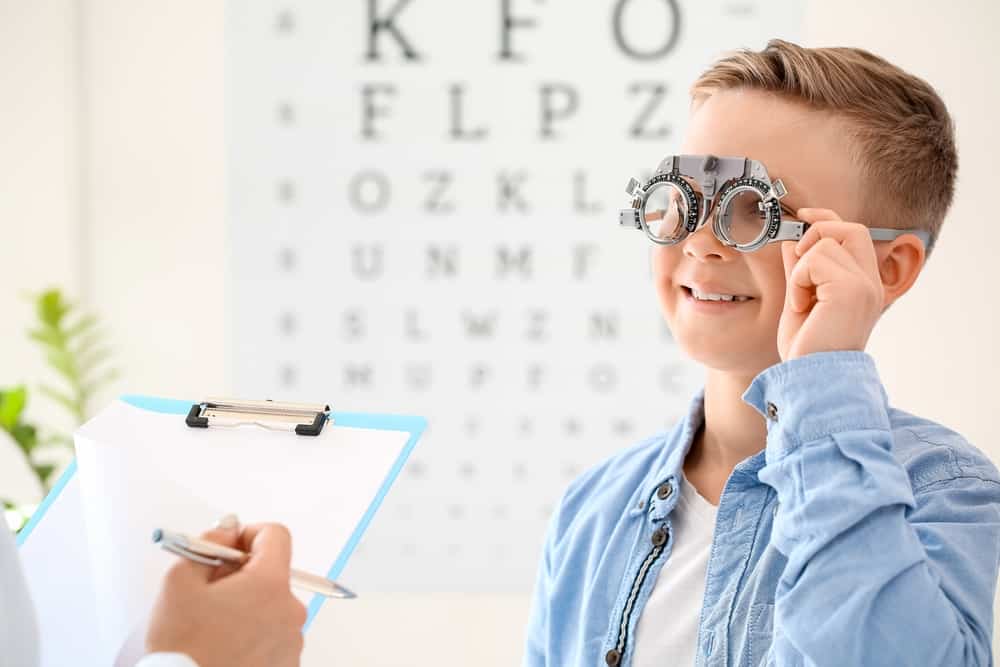
A comprehensive pediatric eye exam is not the same as a school screening, and it’s not a scaled-down version of an adult exam. We evaluate visual acuity at multiple distances, check how the eyes align and move together, assess the ability to focus and switch focus, and examine the internal and external health of the eye. For younger children who can’t read a chart yet, we use objective techniques that don’t require the child to respond verbally at all.
The difference between an optometrist and an ophthalmologist is worth understanding here, because it causes a lot of confusion. An optometrist — a Doctor of Optometry, or OD — is a primary eye care provider. We examine eyes, diagnose conditions, prescribe corrective lenses, and manage the full range of common eye conditions. An ophthalmologist is a medical doctor who performs eye surgery. For the vast majority of children and families, an optometrist handles everything you need. Ophthalmology referrals are reserved for surgical cases or highly specialized conditions.
If your child’s pediatrician has flagged a concern, or if you’ve noticed squinting, eye rubbing, a tendency to hold books very close, or complaints about headaches after reading — those are all reasons to schedule sooner rather than later. And if nothing has been flagged but your child has never had a comprehensive exam, that’s reason enough on its own.
Eye Care as a Core Part of Adult Family Health in Suffolk County
Adults tend to think about eye care in one of two ways: either they need new glasses and it’s time to update the prescription, or their vision seems fine and there’s no reason to go. Neither framing captures what a comprehensive eye exam actually does.
The eye is the only place in the body where blood vessels can be examined directly and non-invasively. A thorough exam can reveal early signs of diabetes, high blood pressure, and certain neurological conditions — often before a patient has any other symptoms. For the 95% of Suffolk County residents who have health insurance, this kind of preventive screening is typically covered under medical benefits, not just vision plans.
How Often Should Adults in Suffolk County Schedule an Eye Exam?
The general guideline is every one to two years for healthy adults, and annually for anyone over 60, anyone with diabetes, or anyone with a family history of glaucoma or macular degeneration. Those aren’t arbitrary numbers — they reflect how quickly certain conditions can progress and how much easier they are to manage when caught early.
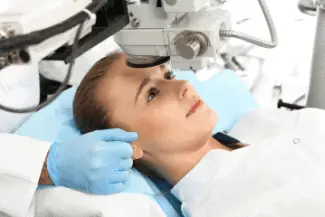
Glaucoma is a good example. It’s often called the “silent thief of sight” because it causes no pain and no obvious symptoms in its early stages. By the time someone notices their peripheral vision is narrowing, meaningful damage has already been done. The only way to catch it early is through a dilated exam and intraocular pressure measurement — neither of which happens at a vision screening kiosk or an online prescription renewal service.
Macular degeneration follows a similar pattern. It’s the leading cause of vision loss in adults over 50, and it’s far more manageable when identified before central vision is affected. Suffolk County’s median age is 41.7 years, and 18% of residents are 65 or older — which means age-related eye disease is a real and present concern for a significant portion of the population, not a distant future problem.
Diabetic retinopathy is another condition where the timing of detection makes an enormous difference. Suffolk County’s demographics reflect national trends in diabetes prevalence, and the retinal changes caused by uncontrolled blood sugar can be spotted in an eye exam before a patient has any visual symptoms at all. In some cases, we’re the first provider to flag that something needs attention.
The takeaway for adults is straightforward: a comprehensive eye exam is not just a prescription update. It’s a health screening that covers territory your primary care physician isn’t equipped to assess.
Finding an Eye Doctor in Port Jefferson Station Who Can Handle Your Whole Family
Suffolk County has no shortage of optical options, but there’s a meaningful difference between a vision center inside a retail store and a full-scope primary eye care practice. The distinction matters more than most people realize until they need something beyond a basic prescription.
We handle comprehensive exams for all ages, manage chronic conditions like glaucoma and dry eye disease, fit specialty contact lenses for patients who’ve been told elsewhere that contacts aren’t an option, co-manage LASIK surgery, and treat acute conditions like red eye, infections, and foreign body removal. Having all of that under one roof — with licensed optometrists and state-licensed opticians — means your family isn’t being referred around every time a need falls slightly outside the routine.
The specialty contact lens piece is worth singling out because it affects more people than you’d expect. Patients with keratoconus, high astigmatism, post-surgical eyes, or very strong prescriptions are often told they’re “difficult to fit” and left without a workable solution. That’s not a universal truth — it’s a reflection of whether the practice has the training and equipment to handle complex cases. We frequently find a solution where others have given up.
For working families in Port Jefferson, Setauket, Coram, Selden, or Centereach, practical factors matter too. We offer evening hours on Mondays and Tuesdays until 7pm, Saturday morning availability, and online booking so you can schedule without taking a day off work. In a county where the average commute runs over 31 minutes, that kind of scheduling flexibility isn’t a small thing.
The Route 112 corridor in Port Jefferson Station sits at the center of a well-developed healthcare cluster — with St. Charles Hospital, pediatric dental practices, and primary care offices all within close range. Choosing providers in that area means your family’s care is geographically connected, which simplifies everything from referrals to follow-up appointments.
Building a Complete Family Healthcare Plan in Suffolk County
A solid family healthcare plan isn’t complicated, but it does require being intentional. A trusted pediatrician, a dentist, a primary care physician for adults, and an eye doctor who can see the whole family — those four relationships cover the vast majority of what most families need on a regular basis.
Vision care earns its place in that list not just because glasses and contacts matter, but because the eyes offer a window into overall health that no other routine appointment provides. For children, early detection of vision problems can change the trajectory of their school experience. For adults, it’s one of the most efficient forms of preventive screening available.
If your family is overdue for an eye exam — or if you’ve never established care with a local eye doctor — we’ve been serving families across Suffolk County from Port Jefferson Station for over 25 years. We offer evening and Saturday hours, online booking, and we take the time to explain what we find. That makes it a straightforward place to start.