
Summary:
Telehealth is everywhere now, and it makes sense that people are wondering whether it works for eye care too. If you can see a doctor on your phone for a sinus infection, why not a blurry prescription? It’s a fair question. The honest answer is: sometimes virtual eye care works well, and sometimes skipping the in-person exam is a decision you’ll regret later. This page walks you through exactly what telehealth can and can’t do for your eyes — so you can make a genuinely informed choice, not just a convenient one.
Telehealth Eye Care: What Virtual Visits Can Actually Do
Virtual eye care has a legitimate role, and it’s worth understanding what that role actually is. For patients with a recent, stable prescription who are between the ages of 18 and 39, a telehealth consultation can be a reasonable way to renew glasses or contact lens prescriptions without driving in. Follow-up visits for known, stable conditions — like discussing dry eye management or medication adherence — can also work well over video.
Telehealth is also useful for triage. If you wake up with a red eye or sudden eye strain and you’re not sure whether it warrants an emergency visit, a quick virtual consultation with a licensed optometrist can help you figure out your next move. That kind of access has real value. The problem starts when patients assume a virtual visit covers everything a comprehensive in-person exam does — because it doesn’t come close.
Eye Exam Offices vs. Online Vision Tests: These Are Not the Same Thing
This is probably the most important distinction to understand before you make any decisions about your eye care. An online vision test — the kind you take on your phone or laptop through an app — is a software program. It runs you through a series of prompts and spits out a refraction result. There is no doctor reviewing your case in real time. The American Optometric Association has explicitly warned that these tools “can offer misleading information” and may leave patients believing their eye health needs have been met when they simply have not been.
A legitimate telehealth eye exam is different. It involves a licensed optometrist on a live video call, reviewing your history, discussing your symptoms, and making clinical decisions. It’s still limited by what can’t be done through a screen, but it’s a professional medical encounter — not an algorithm.
The confusion between these two things is widespread, and it matters. A patient who uses an online vision test app to renew their contact lens prescription hasn’t had an eye exam. They’ve had a refraction test. Those are not the same thing, and the gap between them is where serious conditions get missed.
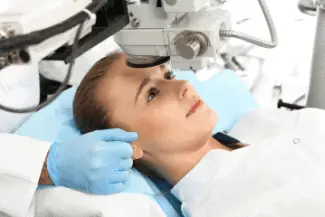
Here’s the core issue: the most dangerous eye diseases — glaucoma, diabetic retinopathy, macular degeneration — have no early symptoms. Your vision can feel completely normal while one of these conditions is quietly progressing. No online test or telehealth platform can detect them, because detecting them requires physical equipment: a slit lamp to examine the front of the eye, instruments to measure intraocular pressure, a dilated pupil exam to see the retina and optic nerve. None of that exists in an app.
Patients over 40, patients with diabetes, and anyone with a family history of glaucoma or macular degeneration are in a particularly high-risk category if they rely on virtual care as a substitute for a comprehensive exam. For these patients, the stakes of skipping the in-person visit are genuinely high.
When In-Person Eye Care Is Not Optional
There’s a version of this conversation where everything is nuanced and balanced, and then there’s the practical reality: for most people, most of the time, a comprehensive in-person exam is what their eye health actually requires. Telehealth fills a narrow, specific role. In-person care covers everything else.
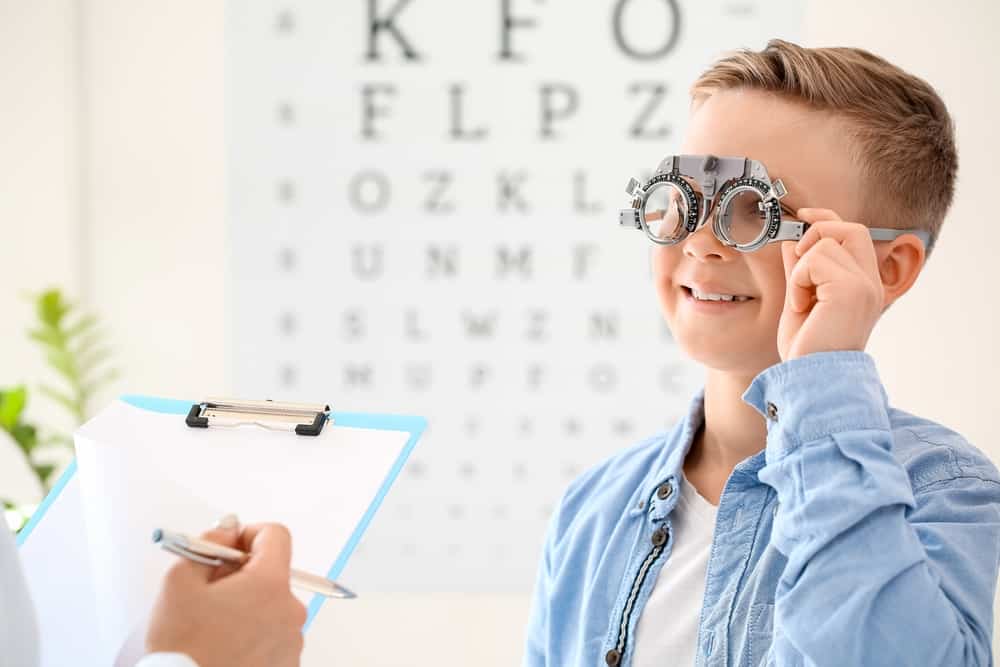
Children need in-person exams, full stop. Pediatric eye care requires hands-on testing that simply cannot be replicated on a screen. A child who appears to see fine may have amblyopia — commonly called lazy eye — that will only get harder to treat the longer it goes undetected. No telehealth platform can catch that.
Contact lens patients also fall firmly in the in-person category. Fitting contact lenses requires a physical assessment of corneal curvature, tear film quality, and how the lens actually sits on the eye. This is especially true for patients with astigmatism, keratoconus, or anyone who needs scleral or gas-permeable lenses. These patients have often been told by other providers that their eyes are “too difficult” to fit — which is usually a sign they need a more experienced practice, not a virtual one.
And then there’s the broader category of ocular disease management. Glaucoma monitoring requires visual field testing and intraocular pressure measurements taken with clinical equipment. Macular degeneration requires retinal imaging. Diabetic retinopathy requires a dilated fundus exam. These aren’t optional add-ons to a comprehensive eye visit — they are the exam. Telehealth cannot perform any of them.
The practical takeaway is straightforward: if you’re under 18, over 40, diabetic, managing any known eye condition, or due for a comprehensive exam, a virtual visit is not a substitute. It might be a useful complement for follow-ups or quick triage questions, but it cannot replace the full picture that an in-person exam provides.
Advanced Eye Vision Optometry in Suffolk County, NY: What In-Person Care Actually Looks Like
We’ve been practicing in Port Jefferson Station for over 32 years, serving patients across Suffolk County from Brookhaven to Smithtown, Huntington, Islip, and beyond. Many of our patients have been coming to us for decades, and that continuity matters clinically, not just personally. When we know your eye history, we can catch changes that a first-time virtual encounter would have no way of recognizing.
Our practice is a full-scope primary eye care office. That means we handle everything from routine annual exams to the diagnosis and management of glaucoma, macular degeneration, diabetic retinopathy, and cataracts. We have three licensed optometrists and two New York State licensed opticians on staff — which gives us the depth to handle complex cases without sending patients elsewhere.
Why Suffolk County Patients With Complex Eye Needs Come to Our Practice
Long Island traffic is real. Nobody needs to be told that Route 347 or the LIE at the wrong hour is not a pleasant experience. We understand why telehealth is appealing — if you can skip the drive, why wouldn’t you? But the patients who come to us from across Suffolk County aren’t driving in for a routine prescription renewal. They’re coming in because they need something that a screen can’t provide.
We specialize in patients who are difficult to fit with contact lenses. That includes patients with keratoconus, high astigmatism, and those who need scleral or gas-permeable lenses. These patients have often spent years bouncing between providers without getting a lens that actually works. The fitting process requires hands-on assessment — corneal topography, trial lens evaluation, tear film analysis — and it requires a doctor who has done this many times before. Our residency-trained optometrists have that experience, including clinical training at VA hospital settings where complex, high-stakes cases are the norm rather than the exception.
We also see a significant number of patients managing diabetes-related eye disease. The greater Port Jefferson area, and Suffolk County broadly, has a large population of patients living with diabetes — and diabetic retinopathy is the leading preventable cause of blindness in working-age adults. Annual dilated eye exams are not a suggestion for these patients; they are a clinical necessity. A telehealth platform cannot perform a dilated fundus exam. We can, and we do.
Our Monday and Tuesday evening hours — open until 7:00 PM — exist specifically because we know our patients work. Not everyone can take a Tuesday afternoon off. If getting in for a comprehensive exam has felt logistically impossible, that’s something we’ve tried to solve directly.
Eye Care Without Insurance in Suffolk County: What You Should Know Before You Decide
One of the most common reasons patients turn to online vision tests or telehealth platforms is cost. If you don’t have vision insurance — and in Suffolk County, a growing number of residents don’t — a $20 online refraction test looks a lot more appealing than an in-person comprehensive exam. That’s understandable. But it’s worth knowing what you’re actually trading away.
An online refraction test tells you one thing: whether your prescription has changed. It does not examine your retina. It does not measure your eye pressure. It does not check for early signs of glaucoma, macular degeneration, or any other condition that could cost you your vision if caught late. For a patient without insurance who is also over 40, or diabetic, or has a family history of eye disease, a cheap virtual test is not a bargain — it’s a gap in care that may not show consequences until it’s too late to reverse them.
For patients paying out of pocket, the more useful question is: what does a comprehensive in-person exam actually cost, and what does it cover? Pricing varies by practice and by the specific services involved, and we’re transparent about that. What we’d encourage any uninsured patient to consider is the full picture — not just the cost of the visit, but the cost of missing something that a thorough exam would have caught.
We’ve seen patients come in after years of relying on prescription renewal apps, only to discover early-stage glaucoma or retinal changes that needed immediate attention. In those cases, the money saved on virtual visits was far outweighed by the urgency of what had been missed. The better approach for uninsured patients isn’t to skip the comprehensive exam — it’s to find a practice that’s upfront about costs and genuinely thorough in what they check. That’s what we try to be.
If you have questions about what an exam covers or what to expect cost-wise, call us before you book. We’d rather answer your questions upfront than have you walk in with uncertainty.
Choosing the Right Eye Care in Suffolk County, NY: What Actually Matters
Telehealth eye care is a real and useful tool — in the right situations, for the right patients. Prescription renewals for healthy, stable eyes in younger adults, quick triage for minor symptoms, follow-up conversations for known conditions — these are areas where virtual visits add genuine convenience without meaningful compromise.
But the most important parts of a comprehensive eye exam cannot happen through a screen. Measuring eye pressure, examining the retina, fitting contact lenses, assessing a child’s vision development — these require equipment, training, and a doctor who is physically present and paying attention. For most patients, most of the time, that’s what their eyes actually need.
If you’re in Suffolk County and you’re weighing your options, we’d encourage you to think about what you’re actually trying to get from an eye visit — and whether a virtual platform can genuinely deliver it. If you’re due for a real comprehensive exam, or if you’ve been relying on online tests longer than you should have, North Shore Advanced Eyecare is here to give your eyes the full picture.